
European Roulette Online in the UK: Wheels and Play
 Available in GB
Contents
Learn how the single-zero wheel, table bets, online formats and bonus terms shape European roulette play.
European Roulette’s Single-Zero Wheel
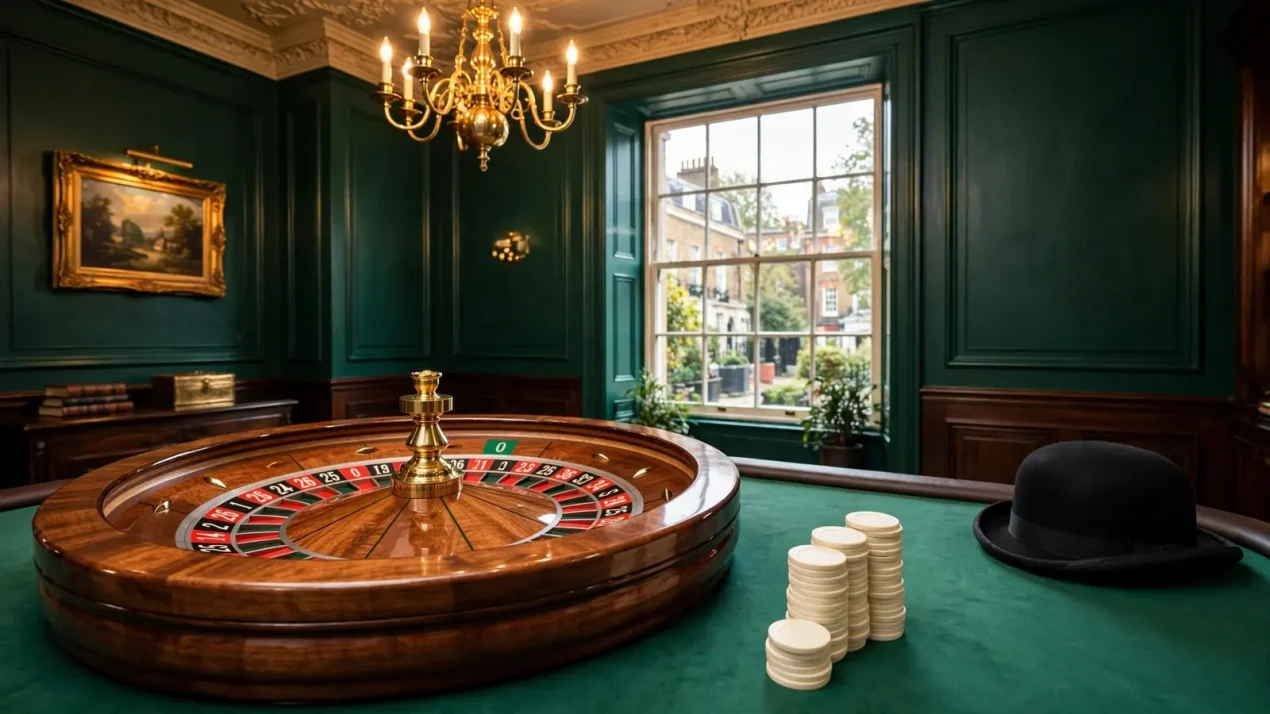
European roulette is defined by a wheel with 37 pockets: the numbers 1 to 36 and one zero. That single green pocket distinguishes it from the American wheel, which adds a double zero and has 38 pockets in total. The difference is small in appearance but central to how the two versions are identified.
The numbered pockets are arranged around the wheel in an order that is not simply ascending. Their sequence is separate from the betting layout and does not alter the pocket count. For a player encountering an online European roulette casino game, the defining feature remains the same whether the wheel is shown as a digital animation or represented by a physical wheel in a live stream: there is one zero, not two.
This makes the comparison in European roulette vs American roulette straightforward at the level of wheel design. European roulette contains 37 possible stopping positions, while American roulette contains 38. In the latter, the extra double-zero pocket is a distinct outcome; it is not another name for the single zero. The added pocket changes the set of possible results without changing the familiar sequence of numbered outcomes from 1 to 36.
A game labelled European roulette should therefore be understood as the single-zero version. The label describes the wheel’s pocket arrangement, rather than a particular interface, dealer style or pace of play. Those features may differ between casino products, but they do not change what makes the European wheel European. Its defining structure is the 36 numbered pockets alongside a single zero.
That distinction provides a precise starting point for identifying the game. The American wheel has the same numbered range but includes both zero and double zero, giving it one additional pocket. European roulette has only the single zero, and that is the essential difference between the two wheel variants.
Reading the European Roulette Table Layout
A European roulette table translates the wheel’s numbered pockets into a flat betting surface. The layout is not arranged in the same order as the numbers around the wheel: instead, the numbered betting spaces appear in three horizontal rows, with a separate green zero space at one end. This arrangement groups wagers by the numbers they cover rather than reproducing the wheel’s sequence.
Casino Games: Slots, Table Games and Live Play
The main grid contains numbers from 1 to 36. Each number has its own rectangular space, allowing a wager to be placed on an individual number or on a boundary shared with neighbouring spaces. The zero sits outside the three rows, distinguished by its green colour. Its position matters because wagers covering numbered spaces do not automatically include zero; the betting area must explicitly cover it.
The grid is surrounded by broader betting areas. Along the sides are options that cover rows or columns of numbers, while the outer edge offers choices based on colour, parity, or whether a number is in the lower or upper half of the numbered range. These are still defined by the numbered pockets, even though each covers several outcomes. The felt therefore presents both precise positions and wider groupings on one surface.
A European roulette casino table may display the same layout in different visual styles, but the boundaries between spaces determine which numbers a chip covers. A chip placed inside one numbered box marks a single-number wager. A chip placed on a line or intersection can cover adjacent numbers, depending on the exact position. At the outer sections, the marked labels identify the group included in the wager. Reading those borders is more reliable than relying on colour or proximity alone.
The layout also helps distinguish a wager’s coverage from its eventual return. It shows which outcomes are included, not how much a winning wager pays. That distinction is useful when comparing a table’s betting areas with the rules displayed by the casino; payout details belong to the game’s paytable.
Understanding the table does not create a predictive European roulette strategy. The arrangement organises possible wagers, but it cannot indicate where the ball will land. A clear reading of the grid can prevent placing a chip in the wrong area; it does not alter the chance-based outcome of a spin.
Attention: Understanding the table layout prevents placing chips in the wrong area, but it cannot indicate where the ball will land or alter the chance-based outcome of a spin.
Inside Bets, Outside Bets and Payouts
On a European single-zero table, betting options are commonly grouped as inside or outside bets. The distinction concerns where the wager is placed on the betting surface and how many numbers it covers. Inside bets select a specific number or a small group of numbers; outside bets cover broader categories. The payout is higher for wagers covering fewer numbers, while broader selections return less if they win.
A straight-up bet selects one number. Its quoted payout is 35:1, meaning the return is calculated against the stake at that ratio. This is the same straight-up payout offered on American roulette, despite the difference in wheel pockets. The shared payout does not make the variants equivalent: the number of pockets affects the chance of a winning result.
A split bet covers two adjacent numbers and pays 17:1. A street bet covers a horizontal row of three numbers and pays 11:1. These are also inside bets, but each covers more possible results than a straight-up selection. Their lower quoted returns reflect that broader coverage. The table’s markings indicate the numbers included in each selection; the bet itself does not alter the outcome or the wheel’s underlying probabilities.
Outside bets and even-money returns
Outside bets include red or black, odd or even, and low or high numbers. Each pays 1:1. These choices cover broad groups, so their return is smaller than the quoted return for a single-number wager. The labels describe the selection, not a guarantee that one side will appear equally often: zero is green and is not part of the red/black, odd/even or high/low groups.
That distinction matters when interpreting “even-money”. The phrase refers to the 1:1 payout, not to a promise that the chance of winning is exactly one half. On a European wheel, the zero prevents the listed outside groups from covering every pocket. The house edge for European roulette is 2.70%, so the payout schedule does not produce an even long-run balance between stakes and returns.
Online Casino Games for Real Cash in the UK
Comparing the quoted payouts
The payout figures describe what a winning bet returns relative to its stake; they do not show how frequently the bet will win. A straight-up bet offers the largest listed ratio, but it covers only one number. A split and a street cover more numbers, with correspondingly lower ratios. Red/black, odd/even and high/low cover broader categories and pay 1:1.
These figures are useful for comparing bet structures, not for identifying a selection that can predict the next result. Each spin remains uncertain, and the payout alone cannot establish whether a wager is favourable. Understanding both the covered numbers and the quoted return gives a clearer account of what each inside or outside bet offers.
Playing Online: RNG, Speed and Minimum Stakes
Online European roulette is available in formats that differ mainly in how each spin is produced and how quickly play proceeds. In RNG roulette, software uses a random number generator to determine the result. The format removes the need to wait for a dealer to conduct each round, so play can move faster and minimum stakes can be lower. Some RNG games have minimum bets as low as 10p, although the amount depends on the table offered.
That can make RNG play a practical way to play European roulette online when a lower stake or quicker sequence of rounds is preferred. The interface still presents a roulette game, but the result comes from the software’s random process rather than a physical ball landing on a wheel. A faster sequence also means that decisions and stakes recur more often; it does not make outcomes more predictable.
In RNG roulette, the result is determined by software using a random number generator, which allows for a faster pace of play and potentially lower minimum stakes compared to live formats.
Speed roulette is another format designed to increase the pace. A specialist review reports rates above 150 spins per hour for speed roulette, compared with 80–100 spins per hour at a standard table. These figures describe a particular reported comparison, not a guaranteed rate across every casino or game. Table rules, interface design and the time taken to place bets can affect the pace experienced in practice.
Minimum stakes are also format-dependent. A specialist review reports that UK live roulette tables can begin at 10p, while auto-roulette and speed formats sometimes have 5p minimums. These are reported starting points rather than a promise that a particular table will offer them. The displayed table rules are the relevant source for the stake required to join a game.
The term “auto-roulette” can refer to a format in which a machine operates the wheel while the game is presented online. It should not be assumed to mean the same thing as RNG roulette: one involves a physical wheel, while the other simulates spins using software. The available pace and minimum stake can therefore vary even where the games look similar on screen.
For someone deciding how to play European roulette, the distinction is practical: RNG tables prioritise software-generated rounds, while speed and auto formats may alter the pace or the way the wheel is operated. A lower minimum stake changes the amount needed for an individual bet, not the roulette rules or the uncertainty of a spin. Faster play can also mean that a session uses more bets in less time, so pace is relevant to how quickly funds are staked.
Online Casino Tournaments UK: Rules and Evidence
Searches for free play and real-money European roulette lead to different kinds of sessions, but the format comparison remains useful in either case. A demo can show how a game interface works without requiring a real-money stake; availability depends on the game and operator. For real-money play, the advertised minimum should be checked on the specific table rather than inferred from another version of the game. A “VIP” label does not, by itself, establish a particular minimum stake or spin rate.
European Roulette Casinos: Comparing Bonus Terms
A casino bonus is not defined by its headline value alone. Its conditions determine which games count towards the wagering requirement and how much each eligible bet contributes. For roulette, that game weighting can differ between operators and between formats. A comparison of European roulette casinos is therefore more useful when it examines the rules attached to the bonus, rather than treating every roulette wager as equivalent.
UK operator terms commonly assign roulette a contribution of 10% to 20% towards bonus wagering. This means a roulette bet may advance the requirement more slowly than a bet on a game with a higher weighting. The precise effect depends on the operator’s published conditions: the contribution rate, the games included and whether the rate differs for live and RNG roulette all matter. A low advertised wagering requirement can be less favourable in practice if the preferred game contributes only a small share of each stake.
The distinction between RNG and live roulette is particularly relevant. RNG roulette is generated by software, while live roulette is streamed from a studio; bonus terms may treat the two formats differently. In the described operator terms, live roulette may count at 10% or 20%, whereas RNG roulette often counts at 100%. These are not universal rates. The wording for the specific promotion and game must establish which category applies, since a game’s roulette label alone does not show how it is weighted.
RNG Roulette
Often counts at 100% towards bonus wagering requirements.
Live Roulette
Commonly assigned a lower contribution rate, often between 10% and 20%.
No-Deposit Bonuses
Live roulette may be excluded or have very low contribution rates (0% to 10%).
No-deposit bonuses require separate attention. Some UK operators exclude live roulette from wagering on these offers; where it is included, a specialist review reports contribution rates from 0% to 10%. That range describes terms identified in such a review, not a fixed rule for the market. It is especially important to distinguish exclusion from low weighting: an excluded game does not help meet the requirement at all, while a low-weighted game contributes only partially.
Bonus terms also define the scope of eligible play. Conditions may distinguish between game formats or particular promotions, so the general casino policy should not be assumed to govern every offer. The relevant terms are those attached to the bonus being considered. If the promotion excludes a live table, or assigns a different rate to it, a general statement about roulette weighting does not override that condition.
A regulatory update report describes a change taking effect in January 2026: bonus wagering requirements for licensed operators are capped at ten times the bonus amount. That ceiling does not make offers equivalent. The game-weighting rules still affect how quickly qualifying play can satisfy a requirement, and other conditions remain relevant. A capped requirement paired with low roulette weighting can still require substantially more roulette play than a player might infer from the headline offer.
A sound comparison of online casinos with European roulette should therefore separate several questions: whether roulette is eligible, whether the terms distinguish RNG from live play, what contribution applies to each format, and whether no-deposit offers have additional exclusions. The stated wagering requirement and the weighting rate work together; neither gives a complete picture on its own. The terms should also be checked for the applicable promotion and any conditions that affect when bonus funds can be used or withdrawn.
Searches for the best European roulette casinos may suggest that one operator can be named as the strongest choice for every player. Bonus conditions do not support such a simple ranking: the result depends on the format played and the exact offer. A casino that gives RNG roulette a higher weighting may be more suitable for someone choosing that format, while its live tables may contribute at a lower rate or be excluded from a particular bonus. This is a comparison of conditions, not a guarantee that a bonus will be easy to clear.
Online Casino Without ID in the UK: Checks Explained
The practical measure is not the bonus headline in isolation, but how the published rules apply to the intended roulette format. Where terms are unclear about game weighting, the offer cannot be compared reliably on that point. Current promotion wording should be treated as controlling, since contribution rates and eligibility may differ across offers at the same operator.
Choosing a European Roulette Casino on Evidence
A comparison of European roulette casinos is more useful when it examines verifiable features than when it declares a single operator the best. The relevant evidence includes the game’s stated return to player (RTP), the identity of the game and its provider, and whether the casino is authorised to offer real-money gambling in Great Britain. These points help distinguish documented terms from promotional claims; they do not remove the uncertainty inherent in each spin.
Check the game’s published RTP
RTP expresses the proportion of stakes a game is designed to return over an extended period of play. For European roulette, the house edge is 2.70%, a theoretical measure of the casino’s long-run advantage. It is not a forecast of what an individual session will return: results can vary, and a short run of spins may differ substantially from the theoretical expectation.
RTP information should be accessible before play, rather than difficult to locate or presented without identifying which game it describes. A casino comparison should therefore check the game’s own information panel or rules, and establish that the stated RTP applies to the specific European roulette title being considered. Where a figure is absent, unclear or attached to a different game, there is not enough evidence to treat it as a reliable comparison point.
Online Bingo in the UK: Games, Slots and Prizes
The game’s title and provider also matter because a casino may offer more than one roulette product. A page labelled as a European roulette slot, for instance, should not be assumed to describe a conventional roulette game: the format and rules need to be checked directly. The name alone does not establish how the product works or what RTP applies.
Treat fairness claims cautiously
A published RTP describes the mathematical profile of a game, not proof that every outcome can be predicted or controlled. Roulette results are determined by chance, so betting patterns cannot identify the next result. No strategy can convert the game’s probabilities into certainty.
The Martingale system illustrates the limits of staking strategies. It calls for doubling the wager after each loss in an attempt to recover earlier losses when a win eventually occurs. That sequence does not change the odds of a spin. A losing streak can also put substantial pressure on a player’s bankroll, because each successive wager grows while the losses accumulate. The system is therefore a staking approach, not a method for forecasting outcomes or reducing the game’s underlying house edge.
Verify the operator’s status and controls
In Great Britain, real-money online casino play is legal only through an operator with the relevant UK Gambling Commission (UKGC) licence. A platform without a valid UKGC licence cannot legally offer real-money roulette to British residents. Licence status can be checked against the UKGC public register before depositing; a casino’s own description of its regulatory position is not a substitute for that record.
A UKGC-licensed casino must verify a customer’s age before permitting a deposit. It must also provide tools for managing gambling, including deposit and loss limits, session reminders, reality checks, cool-off periods and GamStop self-exclusion. New customers must be prompted to set a financial limit before their first deposit, with account-level controls available afterwards. The presence and accessibility of these features are practical comparison points, not evidence that outcomes are more favourable.
A sound assessment of the best online casino for European roulette therefore rests on identifiable game information, a clearly stated RTP and verifiable regulatory status. Where those details cannot be confirmed, a ranking would imply more certainty than the available evidence supports.
Betting Systems
Staking strategies like the Martingale system do not change the odds of a spin and can put substantial pressure on a bankroll as losses accumulate.
European Roulette Online in the UK: Rules and Variants
European roulette is a rule set, not a guarantee that every online table will play identically. The single-zero format is the reference point, while French roulette applies additional rules that change how certain outcomes affect bets. In an online casino, the distinction matters because a game’s label alone does not establish which rules are active. The displayed table rules should identify the variant and explain what happens when the ball lands on zero.
For a standard European game, the house edge is 2.70%. That figure describes the mathematical disadvantage built into the rules over repeated play; it does not predict the result of an individual spin or a short session. The zero is central to that calculation. Even-money bets such as red or black would otherwise appear balanced, but the zero prevents them from being true 50/50 wagers under standard European rules.
La Partage changes the treatment of those bets. If the ball lands on zero, half of an even-money stake is returned rather than the entire stake being lost. On those wagers, this reduces the house edge to 1.35%. The rule does not apply to every type of bet, so its effect should not be read as a general reduction across all wagers on the table. A player making other selections does not receive the same stated advantage from La Partage.
French roulette combines La Partage with En Prison and has the lowest house edge among standard roulette variants. The two rules concern the effect of zero on bets, but their presence does not make all French roulette games identical in presentation or terms. The precise rule set remains relevant: the game information should clarify whether La Partage, En Prison, or both are available and which wagers they cover. Without that detail, the French label alone is not enough to establish the advantage applying to a particular bet.
Live Dream Catcher Casino UK: Availability and Checks
These distinctions are useful when comparing an online European roulette casino with a French roulette table. A game may share the familiar numbered layout while applying a different zero rule. The payout display and rules panel are therefore more informative than a broad description such as “European roulette”. They indicate whether a table uses the standard treatment of zero or offers a rule that changes the outcome for eligible even-money bets.
The mathematical edge should also be kept separate from the chance of winning a particular spin. La Partage alters the expected loss on specified wagers, but it does not provide a method for forecasting where the ball will land. Nor does French roulette remove the house advantage: it reduces it under the relevant rules. Past results do not alter the probabilities of later spins, and a sequence of outcomes is not evidence that a particular colour or number is due.
UK licensing and game rules
In Great Britain, the UK Gambling Commission (UKGC) is the regulator for online casino activity. Remote gambling operators serving the British market must hold the appropriate UKGC licence, irrespective of where the operator is based. Real-money roulette offered to British residents by a platform without a valid UKGC licence is not legally authorised for that market. A foreign location or a familiar game title does not replace the required licence.
The legal framework is not identical across every part of the UK. The Gambling Act 2005 sets the relevant gambling framework for England, Scotland and Wales; Northern Ireland is outside the Act’s territorial scope. This distinction does not change the need for a valid UKGC licence when an operator offers real-money gambling into the British market. The UKGC is the sole regulator of online casino activity in Great Britain.
Differences between European and French Roulette
Standard European roulette has a house edge of 2.70%. French roulette can reduce this edge via the La Partage rule (half stake returned on zero for even-money bets, reducing edge to 1.35%) or a combination of La Partage and En Prison.
A licence addresses the operator’s permission to offer gambling; it does not determine which roulette variant a particular table uses. Both questions need to be considered separately. The licence status concerns whether the service is authorised, while the game rules establish how zero affects a wager and what house edge applies. A UKGC-licensed casino can still provide tables with different roulette rules, so the individual game description remains important.
For an online European roulette casino in the UK, the practical distinction is therefore between the standard single-zero rules and variants that modify the treatment of zero. La Partage provides a defined partial return on eligible even-money bets, while French roulette’s combination of La Partage and En Prison gives it the lowest house edge among standard variants. Those are rule-based differences, not predictions about results or promises of a particular return.
Our top casino picks for the UK
- NightLuckBonus: Welcome Pack + 805% Up To 6400€ + 280 FS · Payout speed: 1-3 business days
- BeOnBetBonus: 100% up to €500 + 100 FS · Payout speed: 1-3 business days
- DieselwinBonus: Welcome Pack 250% up to £4000 + 200 FS · Payout speed: 1-3 business days
- x3betBonus: Welcome Pack 100% Up to £1.000 + 200 Free Spins · Payout speed: 1-3 business days
- BritsinoBonus: Welcome Package – Get your £2,200 + 2,000 FS · Payout speed: 1-3 business days
- SpinFormulaBonus: 550% Up To £15,000 + 550 FS · Payout speed: 1-3 business days
- ChanzeBonus: Slots Welcome Bonus #1 200% up to €500 · Payout speed: 1-3 business days
- Revery PlayBonus: 100% up to€1,000+ 100 FS · Payout speed: 1-3 business days
Roulette Wheels and Live-Dealer Play
An online European roulette game can present either a simulated wheel or a live wheel filmed in a studio. The first is generated by software: a random number generator (RNG) determines each result, which is then displayed on screen. The second shows a physical wheel, a dealer and the ball’s movement in a streamed broadcast. Both formats reproduce roulette play, but they differ in how results are produced and how quickly rounds follow one another.
In an RNG game, the wheel animation is a visual representation of the result rather than a recording of a physical ball landing. The outcome is produced digitally, and a new round can begin without waiting for a dealer to complete the procedure. This makes the pace depend largely on the game interface and the time taken to place bets.
Live play follows a studio process. A human dealer spins the wheel and releases the ball, while the stream carries that event to players. The camera view makes the physical wheel and ball drop observable, but each round must proceed through the dealer’s actions and the betting window. That structure generally makes live play slower than automated play. A published comparison for American roulette gives a typical range of 150 to 200 or more spins per hour for RNG games, against 50 to 60 for live dealer play; those figures should not be treated as a direct measure of every European roulette product.
The visible wheel also differs by format. A live European roulette casino wheel is a physical object in the studio, while an RNG version renders a digital wheel on screen. In either case, a European wheel has a green zero and 37 pockets in total. The distinction is not that one format has a different set of roulette outcomes by definition, but that one displays a simulated result and the other broadcasts a physical spin.
For real-money live roulette in Great Britain, the operator must hold a valid UK Gambling Commission licence. A platform without that licence cannot legally offer real-money live roulette to British residents. Age must be verified before a customer can deposit, and UKGC-licensed operators must provide account-level limit controls. Required safer-gambling tools include deposit and loss limits, session reminders, reality checks, cool-off periods and GamStop self-exclusion. The UKGC public register provides a way to check an operator’s licence before depositing.
Do
- Use the UKGC public register to check license status
- Set deposit and loss limits
- Use session reminders and reality checks
Don’t
- Use a platform without a valid UKGC licence
- Use credit cards for gambling
- Assume a “VIP” label guarantees specific stakes or rates
These protections apply at account level rather than changing the wheel or the way an individual spin is generated. Consequently, the practical choice between RNG and live play concerns the source and presentation of each result, the pace of rounds and the presence of a streamed dealer—not a guarantee of a particular outcome.
Roulette Demos and Lightning-Style Games
A European roulette demo presents the standard roulette format in a non-cash setting. It can show how a virtual table accepts bets and resolves spins, but demo results do not establish anything about real-money outcomes. The wheel’s probabilities remain a matter of chance, and practice play does not make a later result predictable.
The word “slot” in a search for a European roulette slot demo can point to a different product. A roulette-branded slot is a slot game, not a roulette table: its reels, symbols and payout rules are not the mechanics of a numbered wheel. Labels such as 3D, Gold or Platinum may identify particular products or themes, but those terms alone do not establish how a game works. The rules shown within the product determine whether it is a roulette simulation or a slot.
Lightning Roulette is a useful example of why variants should be checked against their own rules rather than treated as standard European roulette. A specialist review reports that a straight-up bet without a lightning multiplier pays 29:1, rather than the 35:1 associated with a standard straight-up win. The same review states that outside bets retain standard roulette odds. The changed straight-up return therefore does not imply that every bet type has been modified.
This distinction matters when comparing a demo with a real-money version. A demo may let players explore the interface, but the displayed game rules and payouts—not the roulette label alone—show what is being simulated. In a variant with special features, the rules should identify which bets can receive a multiplier and what happens to wagers without one. That keeps a roulette-themed slot, a standard roulette demo and a modified roulette game conceptually separate.
The title “European” also does not by itself confirm that a product uses the standard European wheel or payout schedule. Product names can be descriptive rather than sufficient evidence of mechanics. Where the rules are unclear, there is no sound basis for assuming that a roulette-branded game behaves like conventional roulette.
Live European Roulette: Dealer and Bonus Conditions
Live European roulette combines a physical wheel and dealer with online betting through a casino interface. For bonus terms, however, the key distinction is not the setting but the game’s stated weighting: roulette bets may contribute only partially towards wagering requirements, and live games can be treated differently from RNG versions.
A specialist review reports that PartyCasino and Gala Casino list live roulette at a 10–20% contribution rate. This is a reported comparison, not a guarantee that the same terms apply to every promotion or remain unchanged. The applicable bonus rules should be checked for the specific offer, including whether live roulette is eligible and how much each wager counts. If the contribution is low, roulette play may make limited progress towards the required wagering total.
These conditions matter when bonus funds are involved. A game’s inclusion in a casino lobby does not establish that it qualifies for a particular promotion. Terms can distinguish between live and automated roulette, and may exclude some games altogether. The published conditions, rather than the game title or table format, determine whether wagers count.
Payment and dispute arrangements also form part of the practical conditions of play. UKGC-licensed casinos cannot accept credit cards for gambling. They must provide an internal complaints process and access to an approved Alternative Dispute Resolution service if a complaint is not resolved through that process. These protections are separate from bonus eligibility: they do not change how roulette wagers are weighted.
Live play therefore requires attention to two distinct sets of terms: the promotion’s rules for game weighting and the operator’s procedures for complaints and disputes. A stated contribution rate should be treated as specific to the published conditions, not as a general rule for live European roulette across UK casinos.
Related posts

Terms of Use
UK Gambling Casino Sites: Slots, Licensing and Terms